

Canada is the second-largest country on earth, and yet most visitors spend their time in a surprisingly compact band of cities and scenic corridors near the southern border. That contrast, dense, connected urban life set against genuinely vast wilderness, is the key to understanding how to stay online there. Whether you are wandering Vancouver's seawall, catching a show in Toronto, driving the Icefields Parkway through the Rockies, or watching for the northern lights in the Yukon, a Canada eSIM lets you land already connected instead of hunting for a SIM at the airport. This guide sets out where coverage is excellent, where it fades, and how to size your data around the kind of trip you are actually taking.
Photo: Jochem Raat / Unsplash
The case for an eSIM in Canada
An eSIM is a SIM implemented in software: instead of inserting a card, you load a data profile onto the chip your phone already contains. The practical wins for a Canada trip are that you can set it up before you leave, keep your home number live for calls and bank codes, and avoid airport counters and roaming shocks. GetSim provides data-first plans across 190+ destinations, all managed in one app with a single shared prepaid wallet. Before paying, the plan card shows you the network, the data, the validity and the price, so there are no surprises, and if you need more data mid-trip you top up the same plan without reinstalling it. Because most travel plans are data-only, the usual approach is to keep your regular SIM for the occasional text and let the eSIM carry the internet.
Coverage: strong where you will be, thin where you won't
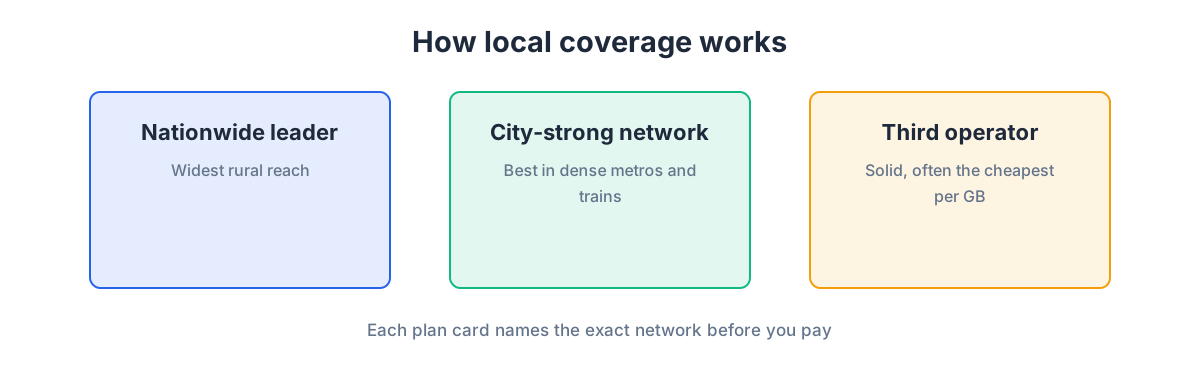
The good news is that the places most travellers go are well covered. The major cities, Toronto, Montreal, Vancouver, Calgary, Ottawa, have dense, reliable data. The busy tourist corridors, Niagara, the Sea-to-Sky highway to Whistler, much of the Trans-Canada near towns, and popular national parks like Banff around the townsites, are generally well served. The market has a familiar shape: a nationwide leader with the widest reach, a strong challenger, and a competitive third operator, and a travel eSIM connects to a partner network rather than asking you to choose a brand. The diagram illustrates that structure.
The other side of the coin is the wilderness. Canada's north and its remote interior, much of the territories, the backcountry of the Rockies, long empty stretches of highway in the Prairies and northern Ontario, and deep provincial parks, have limited or no cellular coverage. On a hike into the backcountry or a drive through the Yukon, expect to be offline for long periods. This is geography, not a defect in any plan. If your itinerary includes remote areas, download offline maps for the whole route, save trail information and bookings so they are readable without signal, and for genuinely remote wilderness consider a satellite communicator. For city and near-town travel, you will rarely notice any of this.
How much data should you buy?
Data appetite in Canada depends heavily on trip style. A city-based visit runs on maps, transit apps, restaurant searches and social media. A road trip through the Rockies leans on navigation and on streaming to fill the long, scenic drives. Video and live navigation are the biggest consumers. The budget diagram sorts typical usage into light, medium and heavy lanes to help you place yourself honestly.
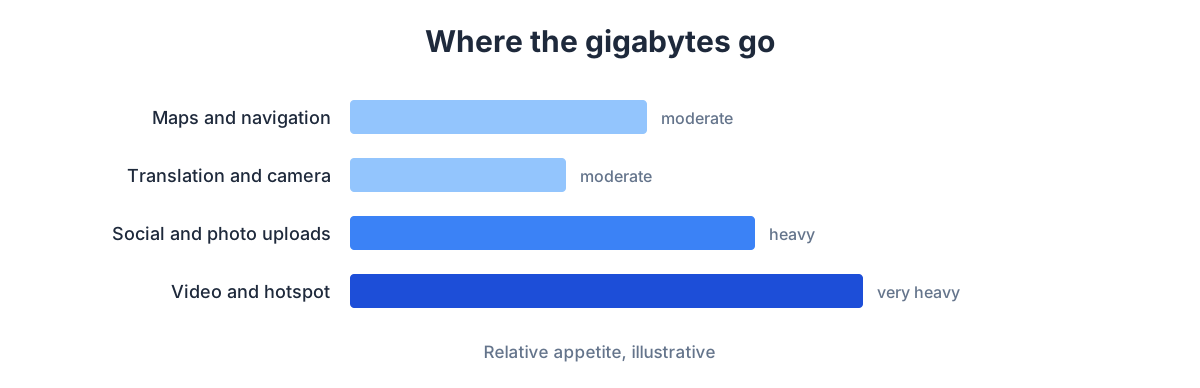
As a guide: if you mostly navigate cities, message and post the odd photo, a small plan is plenty. If you road-trip with hours of live navigation, stream on the drive and video-call home, move up a size, though downloading offline maps for each region trims navigation data a lot. If you are working remotely or hotspotting a laptop, buy generously. The shared prepaid wallet makes running low painless: you add data to the same plan in the app in about a minute, no shop required.
Trip type and data at a glance
| Trip type | What uses the most data | Sensible approach |
|---|---|---|
| City break (Toronto/Montreal) | Maps, transit, social | Small to mid plan |
| Rockies road trip | Live navigation, streaming | Mid to large plan, offline maps |
| National park hiking | Offline maps, light messaging | Small plan plus pre-downloads |
| Northern lights / remote north | Minimal live data, offline everything | Small plan plus a backup device |
| Working remotely | Video calls, laptop hotspot | Large plan, expect top-ups |
Setting up your Canada eSIM
Install the eSIM at home over your own Wi-Fi before you fly. Since you are travelling to Canada from elsewhere, you can prepare it in advance, leave it dormant, and switch it on when you land, which spares you the arrivals-hall Wi-Fi scramble.
- Confirm your phone supports eSIM. Most recent iPhones, Pixels and Galaxy S models do; if unsure, our guide on checking eSIM support shows the fast way to verify.
- Buy the Canada plan in the GetSim app, where the card displays network, data, validity and price before payment.
- Install the profile over home Wi-Fi. The app walks you through it, and the eSIM appears in your cellular or SIM settings.
- Give it a clear name such as "Canada data" so it is easy to manage.
- Keep the eSIM's data off until you arrive, then turn it on and set it as your data line.
Our step-by-step install guide covers both iPhone and Android in detail. Keep your home SIM for calls and codes and let the Canadian data plan handle the rest. A quick note for anyone combining Canada with a hop across the border: a Canada plan covers Canada; for the United States you would want a US plan or a regional plan, so check the USA eSIM guide if that is on your route.
Province by province: how the picture changes
Canada's regions vary enormously, and where you travel shapes how much you lean on your connection. Ontario and Quebec, anchored by Toronto, Ottawa and Montreal, are the best-covered parts of the country, and the popular corridors, Niagara, the Thousand Islands, the drive between Montreal and Quebec City, stay connected near towns. British Columbia is a study in contrast: Vancouver and Victoria are dense and reliable, and the Sea-to-Sky route up to Whistler is well served, but the moment you head into the interior mountains or up the coast, coverage clusters around communities and fades between them.
The Rockies straddling Alberta and BC are a favourite and worth planning for specifically. Banff and Jasper townsites and the busy stretches of the Icefields Parkway have coverage, but the trailheads and backcountry beyond them often do not, so downloading offline maps for every hike is standard practice. The Prairies, Manitoba, Saskatchewan, much of Alberta outside the cities, have long, straight highways where signal follows the towns and thins in the wide gaps between them. And the North, the Yukon, Northwest Territories and Nunavut, is genuine wilderness where cellular coverage is limited to settlements; a trip to see the northern lights or drive the Dempster Highway should be planned around being offline for long stretches, with maps, bookings and a backup communicator sorted in advance.
eSIM versus a physical SIM in Canada
The comparison favours an eSIM for most visitors, and it is worth being concrete about why without inventing any numbers. A physical local SIM means locating a shop, sometimes showing ID, swapping out your home card and safeguarding it, all after a long flight and often in a second language. An eSIM removes each of those steps: you arrange it at home, keep your home number in the phone for calls and codes, and arrive with data live, whether you land in Toronto or a smaller regional airport. The plan card lays out network, data, validity and price before you pay, so nothing is hidden.
Keeping your home line active is particularly valuable on a Canadian road trip, where you may need a bank confirmation or a verification code to book the next lodge from a mountain town. Replace your SIM entirely and those texts can stop arriving. The tidy split, eSIM for data, home number for identity, avoids that, and because the shared prepaid wallet spans destinations, adding a US leg or a later trip elsewhere is a top-up rather than starting over at a store counter.
Habits that stretch your plan
A few simple routines keep your data comfortable. Use hotel and cafe Wi-Fi for photo backups, app updates and long video calls, and save mobile data for when you are out exploring. Download offline maps for every region before you drive, which both saves data and keeps you oriented where signal drops. If you travel as a group, one larger plan shared by hotspot is often tidier than several small ones, bearing in mind hotspotting uses data faster. Switch off video autoplay to curb quiet background usage.
Worth remembering: an unused, unactivated plan is refundable within seven days, so buying ahead of a trip that might change is low-risk. And if you need a number to receive a booking confirmation or a verification code, you can add a receive-only virtual number, since the travel data plan itself does not include a callable line.
What you will actually use your connection for
Picturing the concrete moments a data plan smooths over in Canada makes it easier to judge how much you need. In the cities, it is the familiar travel rhythm: maps between neighbourhoods, transit apps for the streetcar or the SkyTrain, restaurant and coffee searches, and photos shared home across a big time difference. On a road trip through the Rockies or along the coast, navigation dominates, often running for hours, alongside streaming to fill the drives and weather checks before a mountain stretch. Booking the next lodge from the road is routine, which is precisely why keeping your home number reachable for a bank confirmation or verification code can rescue an evening.
The wilderness and northern legs invert the priorities: the aim there is to have downloaded everything, offline maps, trail information, entertainment, and bookings, before the signal fades, rather than relying on live data. Buy your plan around that mix of dense-city and empty-space phases instead of assuming constant connectivity, and you will avoid both overpaying and running short. For a closer look at matching gigabytes to how you actually travel, our guide on how much data you need for a trip is a useful companion, and if you are weighing this against your home carrier's roaming, the eSIM versus roaming comparison lays out the trade-offs.
Frequently asked questions
Will my eSIM work in the national parks?
Around townsites and popular trailheads, often yes; deeper in the backcountry, expect little or no signal. Download offline maps and trail info before you set out.
Does a Canada plan cover the United States?
No. A Canada plan is for Canada. If your trip crosses into the US, choose a US plan or a regional plan that covers both.
Can I keep my normal number?
Yes. Your home SIM stays in the phone for calls and texts while the eSIM carries data. You choose the data line in settings.
How do I top up on a road trip?
Add data to the same plan in the app while you have signal, with no reinstalling and no shop visit, thanks to the shared prepaid wallet.
Is setup complicated?
No. Install at home over Wi-Fi before you fly, keep it off, and activate on arrival. It takes a few minutes.
What if my trip dates change before I travel?
An unused, unactivated plan is refundable within seven days, so buying ahead of a trip that might shift carries little risk. Once a plan is activated it has started, so hold off switching on the eSIM until you actually land in Canada.
Can two people share one Canada plan?
Yes, by hotspotting from the phone that holds the eSIM. It is often tidier than two separate plans on a road trip, though sharing spends data faster, so size the plan up a little if you go that route.
Plan your Canadian connection
Canada is at its best when you can navigate its cities effortlessly and step confidently into its wild spaces knowing you have prepared for the gaps in coverage. An eSIM set up before you fly is the simplest way to get there. Browse the eSIM plans, confirm Canada on the countries page, and if you are combining several countries in North America, look at the regional plans. If you are new to the technology, our primer on what an eSIM is explains it in plain terms before you buy.
Ready when you are
Put this guide to use on your next trip
Travel eSIMs that install in minutes and keep your home SIM active.