
Two ways to stay online abroad compete for your attention every time you fly: turn on roaming with your home operator, or install a travel eSIM. Both connect you to a network in your destination. What separates them is how you pay, how much control you have, and how much you have to think about it. This comparison lays out the real trade-offs, resists the temptation to pretend one wins every time, and tells you exactly which situations favour each.
There is no single right answer that applies to every traveler, and any guide that claims otherwise is selling you something. The best choice depends on your home plan's roaming terms, where you are going, how many countries you will visit, how long you will be away, and how much you value a locked-in price over zero setup. Read on with your own trip in mind and the sensible pick will become obvious well before the end.
Roaming means your home plan reaches across borders and uses a partner network in the country you are visiting, billed back to your home account. A travel eSIM is a separate prepaid data plan you download for the destination, paid for up front and used through a second line on your phone. If the whole idea of a downloaded SIM is new, start with what an eSIM is, then come back for the head-to-head.
The core difference: metered vs prepaid
Almost every practical difference flows from one distinction. Traditional roaming tends to be metered or bolt-on: you either pay per unit as you go, or you buy a roaming pass tied to your contract. A travel eSIM is prepaid and self-contained: you buy an allowance for a set price, and when it is used, nothing keeps charging in the background. You top up only if you choose to.
That single distinction is why the two feel so different in the wallet. With a prepaid eSIM the worst case is that you run out of data, which is annoying but bounded. With metered roaming the worst case is a bill that grew while you were not watching. Many home plans have improved here, and some regions include generous roaming, so this is not a blanket verdict. But the shape of the risk is different, and that shape matters.
Side by side
| Factor | Home plan roaming | Travel eSIM |
|---|---|---|
| How you pay | Metered or a bolt-on pass on your bill | Prepaid allowance, fixed price up front |
| Cost predictability | Varies; can surprise you | Known before you travel |
| Setup | Often just switch roaming on | Buy, scan a QR code, enable roaming on the line |
| Your number | Keeps your number, calls and texts included | Data-only line; number stays on your home SIM |
| Multiple countries | Depends on your plan's terms | Add a plan, or use one regional plan |
| Running out | Keeps charging or throttles | Stops; you top up if you want more |
| Effort | Lowest, if your plan is roaming-friendly | A few minutes of setup, then hands-off |
How roaming charges actually accrue
To choose well, it helps to understand why roaming bills sometimes surprise people. When your home plan roams, it is your operator paying a partner network abroad and passing that cost to you, either folded into a pass or charged per unit of data. The surprises come from the parts you do not see. Background app refresh, cloud photo backup, automatic software checks and map preloading all consume data whether or not you are actively using the phone, and on a metered roaming plan every one of those quiet background megabytes is billable. At home this invisible activity is free, so you never think about it. Abroad, on a meter, it keeps the counter turning while your phone sits in your pocket. That gap between what you feel you used and what the phone actually used is the classic source of a roaming shock.
A prepaid travel eSIM does not remove background usage, but it changes the consequence of it. Instead of adding to a bill, background activity simply draws down an allowance you already paid a fixed price for. When it is gone, it stops rather than keeps charging. The worst case flips from "an unknown bill" to "I need to top up", which is a much calmer place to be. This is the practical heart of the metered-versus-prepaid distinction, and it is why cost-conscious travelers gravitate to prepaid even when a roaming pass looks comparable on paper.
Where roaming genuinely wins
An honest comparison names the cases for the other side. Roaming with your home plan is the better choice when:
- Your plan includes the destination. Some contracts bundle roaming across a whole region at no extra cost. If yours does and the allowance is enough, that is hard to beat for simplicity.
- You need your own number to actively make and take calls and texts without relying on internet apps. Roaming keeps your full voice and SMS service on your usual number.
- It is a very short hop. For an overnight trip with tiny data needs, flipping a switch you already have may be less hassle than any setup.
- You value zero setup above all. If you would rather pay a premium than spend five minutes configuring anything, roaming asks less of you.
Where a travel eSIM wins
The eSIM pulls ahead in the situations most leisure and business travelers actually face:
- You want a price locked in before you go. No meter, no bill to fear. You see the network, data, validity and price on the plan card and decide with all four in hand.
- Your home roaming is expensive or capped. Many contracts charge steeply or throttle hard outside a home region. A prepaid plan sidesteps that entirely.
- You are visiting several countries. A single regional plan can pool one allowance across a whole area, instead of triggering different roaming terms at each border.
- You travel often. One app and one shared wallet covering more than 190 destinations means your next trip is a top-up, not a new arrangement.
- You want your home line quiet. Keep it on for important calls and bank codes with its data roaming off, and let the eSIM carry everything else.
You do not have to choose only one
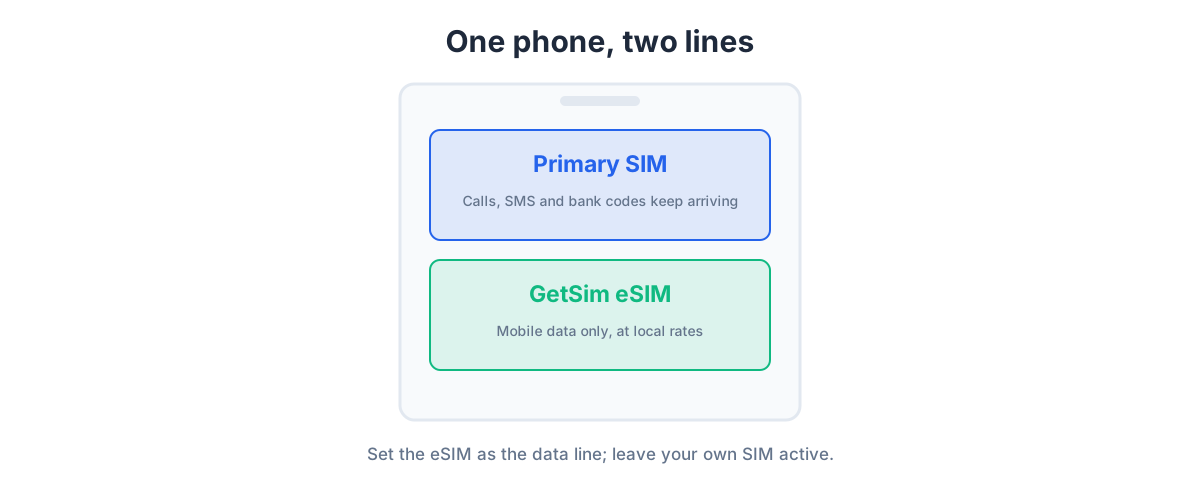
The most robust setup for many travelers uses both, and this is where the dual-line arrangement shines. Your home SIM stays in the phone, kept as the default for calls and texts so your usual number keeps working and verification codes still arrive. Its data roaming stays off, so it never quietly spends money. The travel eSIM sits alongside it as the data line with roaming enabled, carrying maps, browsing, social and streaming at a prepaid price. You get the reachability of your own number and the cost control of a prepaid plan at the same time.
The diagram below shows this two-line layout: which line handles what, and which toggles are on or off.
Coverage is comparable, because it is the same towers
A common worry is that a travel eSIM connects to some inferior fallback network. It does not. A travel plan uses a real local partner network, the same infrastructure a roaming home plan would reach. In most countries the landscape is a nationwide leader with the broadest reach, a strong challenger that is excellent in cities, and a third operator with more regional strengths. Both roaming and a good travel eSIM connect you into that same landscape. Coverage differences between the two are usually about which partner network each uses in a given spot, not about one being a real network and the other not.
A simple way to decide
Run three quick checks and the answer usually reveals itself:
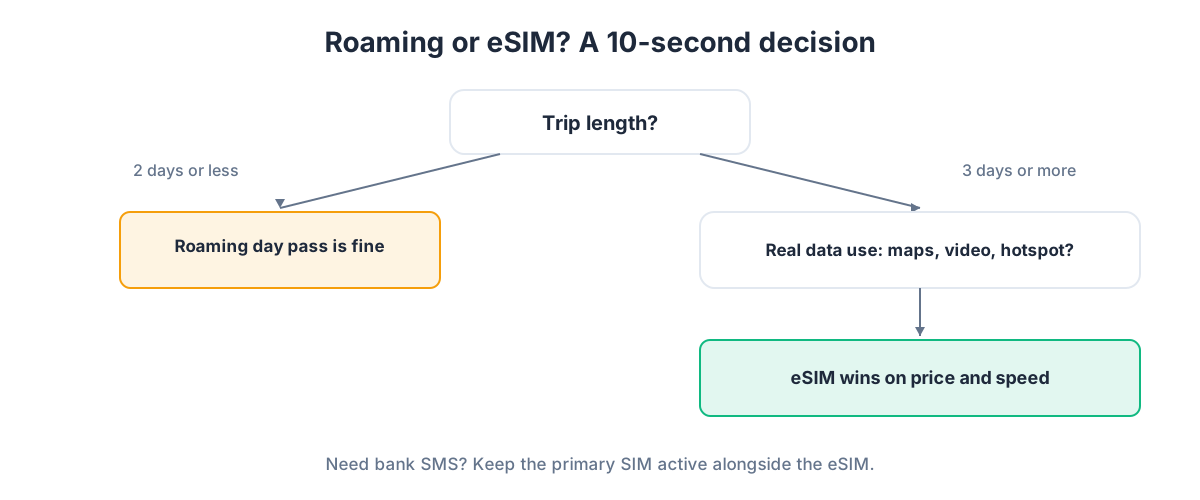
- Read your home plan's roaming terms for the destination. If it is included with a decent allowance, roaming may be the easy call.
- If it is metered, capped or expensive, price a travel eSIM. A fixed prepaid price for the data you expect to use is almost always the calmer choice.
- Count your countries. More than one or two, and a regional eSIM plan tends to win on both price and simplicity.
Still unsure how big a plan to buy if you go the eSIM route? Our guide on how much data you need turns your habits into a sensible size, and the installation guide shows the setup end to end.
Setup effort, weighed honestly
The one area where roaming has a clear edge is effort, and it would be dishonest to gloss over it. If your home plan roams in the destination and you are happy with its terms, staying online can be as simple as leaving your phone alone; the switch is often already flipped. A travel eSIM asks for a few minutes: buy the plan, scan a QR code, set the data line, enable roaming on it. For a seasoned traveler this is trivial and quickly becomes muscle memory, but for a first-timer it is a small learning curve. The fair way to frame it is that the eSIM trades a few minutes of one-time setup for ongoing cost control and predictability. Whether that trade is worth it depends on how much your home roaming would cost and how much you dislike surprises. For most people the minutes are repaid many times over on the first trip; for a rare traveler taking a single short hop on a roaming-friendly plan, the effort may not be worth it.
It is also worth noting that the eSIM's setup effort is front-loaded and non-recurring for a frequent traveler. Once you have done it once, every subsequent trip is a top-up or a new plan added to the same app and wallet, with no fresh account and no relearning. Roaming's low effort, by contrast, is only low as long as your plan's terms happen to suit each destination; the moment you visit somewhere your plan charges heavily, the "just leave it on" simplicity becomes an expensive habit.
The Türkiye timing note
One scheduling detail applies only if Türkiye is your destination. A travel eSIM install cannot be completed while you are physically inside the country, so buy ahead but do the install on arrival over local Wi-Fi. Roaming has no such step because it is already active on your home plan. For every other country, install your eSIM before you fly and land ready.
Frequently asked questions
Is a travel eSIM always cheaper than roaming?
Not always. If your home plan includes roaming in the destination with a large enough allowance, that can be the better deal. The eSIM's advantage is a fixed, known price and no risk of a metered bill, which wins whenever your home roaming is expensive, capped, or excludes where you are going.
Will I lose my phone number if I use an eSIM?
No. The travel eSIM is a separate data line. Your number stays on your home SIM, which remains in the phone. Keep the home line on for calls and texts with its data roaming off.
Can I use both at once?
Yes, and it is the setup many travelers prefer. Home line for your number, travel eSIM for data. The dual-line diagram above shows exactly how to configure it.
What about phone calls on an eSIM plan?
Travel plans are data-only, so voice rides over internet apps. If you need a genuine number to receive calls or verification texts, add a receive-only virtual number alongside your data plan.
Is the connection slower on a travel eSIM than on roaming?
Not inherently. Both use real local partner networks, so speed comes down to which network you are on and the conditions at that spot, not to whether it is roaming or a downloaded plan. A good travel eSIM connects you into the same operator landscape a roaming home plan would reach.
Can I keep receiving verification texts on my number while using an eSIM for data?
Yes. Keep your home line switched on with its data roaming off. Receiving a text needs the line registered, not data roaming, so bank codes and login texts still arrive on your usual number while the eSIM quietly handles all your internet.
Where do I start if I choose the eSIM?
Browse your destination on the eSIM countries pages or start at the eSIM hub. Unused, unactivated plans carry a 7-day refund window, so buying ahead is low risk if your plans shift.
Ready when you are
Put this guide to use on your next trip
Travel eSIMs that install in minutes and keep your home SIM active.