

Thailand is a country you navigate by phone almost from the first hour. You land at Suvarnabhumi tired and excited, and immediately you want a ride-hailing app to reach the hotel, a map of the Grand Palace, a currency converter for the night market, and a way to message the boatman who takes you to your island bungalow. Without data, all of that grinds to a halt at the exact moment you least want friction. A Thailand eSIM solves it cleanly: you arrive already connected, no shop queue at the airport, no plastic SIM to fumble with in the humidity. This guide covers what coverage feels like from Bangkok to the far south, how to size your data, and how to get everything ready before you board.
Photo: Alejandro Cartagena / Unsplash
Thailand at a glance for the connected traveller
An eSIM is simply a SIM built into your phone's software. Rather than slotting in a card, you load a data profile onto the chip that is already there. For Thailand that is a gift, because it lets you handle everything in advance and land ready. You keep your home number in the phone for the odd bank code, and the eSIM carries your internet. GetSim offers data-first plans across 190+ destinations, all run from one app and a single shared prepaid wallet, so a Thailand plan sits alongside anywhere else you travel this year. Before you pay, the plan card lays out the network, the data, the validity and the price, and if you need more later you top up the same plan without reinstalling it.
Coverage from the capital to the coast
Thailand's mobile networks are genuinely good where visitors spend their time. Bangkok is dense and fast, and the main tourist islands and beach towns, Phuket, Krabi, Koh Samui, Pattaya, Chiang Mai up north, are well served because they are busy the year round. Understanding the market helps you set expectations: there is a nationwide leader with the broadest footprint, a strong city-focused challenger, and a competitive third operator. A travel eSIM connects to whichever partner network is strongest for you, so you benefit from that competition without having to choose a brand. The diagram lays out the shape.
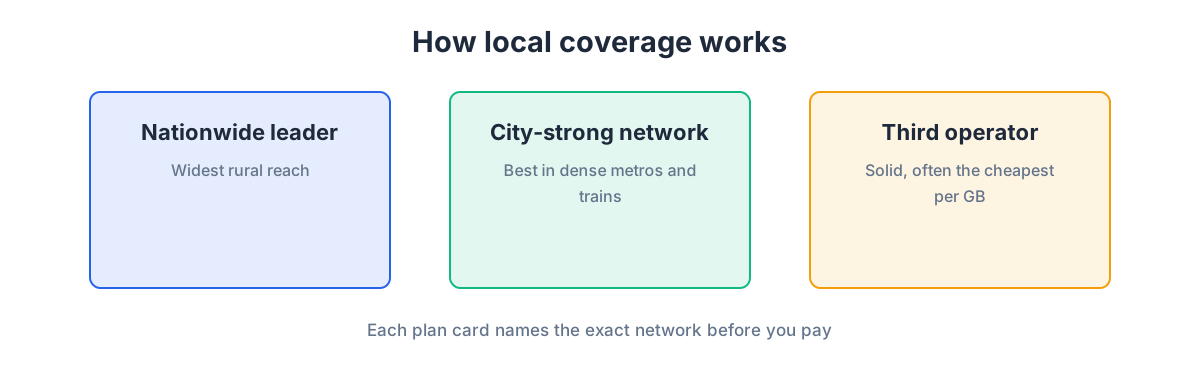
Where the picture gets more interesting is off the beaten track. The smaller islands, some of the Koh Tao and Koh Phangan interior, remote parts of the northern hills around Pai and Mae Hong Son, and dense national parks can see slower or patchier data. On a longboat between islands you may lose signal entirely for stretches; treat that as part of the adventure and download your maps first. In the far south and rural Isaan, coverage exists but thins out between towns. None of this is a reason to worry, it just means a little preparation pays off: cache offline maps of each area and save any ferry or tour confirmations so they are readable without a connection.
Sizing your data honestly
Thailand tempts you to film everything, the street food, the temples, the impossibly blue water, and video is exactly what consumes data fastest. The difference between a light and a heavy user over a two-week trip is dramatic. The budget diagram below sorts usage into three lanes so you can be honest about which one you fall into rather than guessing and either overpaying or running dry.
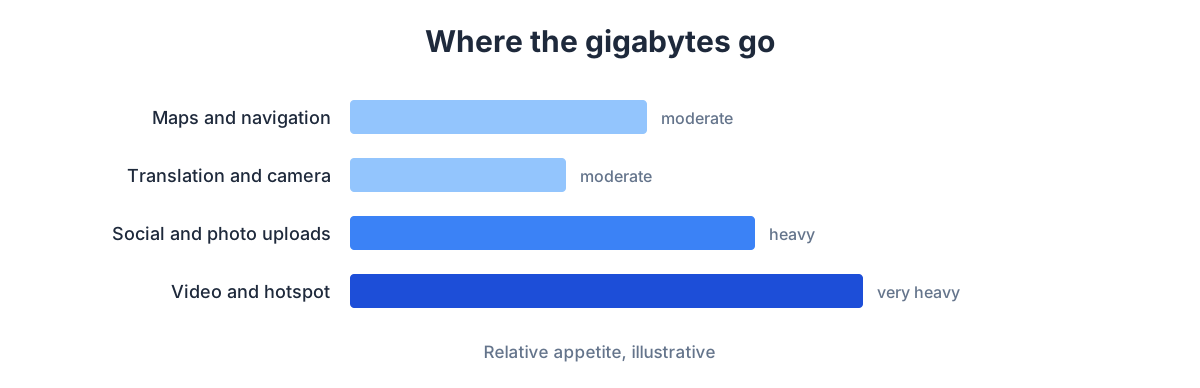
Here is a plain-language way to think about it. If you mainly use maps, ride-hailing apps, messaging and the occasional upload, your data goes a long way and a modest plan will do. If you post daily stories, video-call home each evening and stream music on the beach, move up a size. If you plan to stream shows, hotspot a laptop for remote work, or share one connection between two people, buy generously or plan to top up mid-trip. Because everything runs off the shared prepaid wallet, topping up is a one-minute task in the app, not a scramble for a shop.
Matching your itinerary to a plan
The way you travel Thailand shapes how much data you burn. This table pairs common trip patterns with a sensible approach so you can plan before you buy.
| Itinerary | What drives usage | Approach |
|---|---|---|
| Bangkok city stay | Ride-hailing, maps, food apps | Small to mid plan |
| Island hopping (south) | Ferry bookings, photos, offline maps | Mid plan plus offline downloads |
| Chiang Mai and the north | Navigation, social, some video | Mid plan |
| Beach relaxation | Streaming, daily video calls | Larger plan or top up |
| Digital nomad month | Video meetings, laptop hotspot | Large plan, expect top-ups |
Getting set up before you leave
The golden rule is to install the eSIM at home, over your own Wi-Fi, before you fly to Thailand. You set it up in advance, keep it dormant, and switch it on when you land. That avoids the classic trap of standing in an arrivals hall trying to download a profile on flaky airport Wi-Fi.
- Confirm your phone handles eSIM. Recent iPhones, Pixels and Galaxy S phones generally do; if you are unsure, our guide on checking eSIM compatibility shows the quick way to verify.
- Buy the Thailand plan in the GetSim app, where the card shows network, data, validity and price before you pay.
- Install the profile over home Wi-Fi. The app walks you through it; the eSIM appears in your phone's cellular or SIM settings.
- Name it clearly, for example "Thailand data", so it is easy to manage next to your home line.
- Keep the eSIM's data switched off until you arrive, then turn it on in Bangkok, Phuket or wherever you land, and set it as your data line.
For a fuller walkthrough with menus for both iPhone and Android, see our install guide. With that done, your home SIM stays available for calls and codes while the Thai data plan handles maps, chat and everything else.
Region by region across Thailand
Thailand splits into a handful of very different travel zones, and your connection behaves differently in each. Bangkok and its orbit, Ayutthaya day trips, the floating markets, the bridge over the River Kwai at Kanchanaburi, keep you well within strong coverage for most of the way, softening only in the more rural corners. The northern loop around Chiang Mai and Chiang Rai is comfortable in the cities and along the main roads, but the mountain routes toward Pai and Mae Hong Son wind through valleys where data thins; a downloaded map of those hairpin roads is worth having before you set off on a scooter.
The southern islands are where most people's coverage questions arise. Phuket, Koh Samui and Krabi are busy and reasonably served across their developed areas, so day-to-day browsing is fine. The wilder edges, the interior trails of Koh Phangan, the quieter beaches of Koh Lanta, and above all the boat crossings between islands, are where you should expect to drop offline for stretches. Ferry and speedboat operators know this and often confirm bookings by messaging app in advance, so screenshot every confirmation while you still have signal at the pier. In the far south and rural Isaan in the northeast, coverage follows the towns and highways and thins between them, which rarely matters for a typical itinerary but is worth knowing if you are venturing well off the standard trail.
eSIM versus a SIM bought on arrival
Plenty of travellers still picture buying a SIM at the airport counter, and it is worth spelling out why an eSIM is usually the smoother choice without leaning on any invented figures. A physical SIM means queuing after a long flight, sometimes handing over your passport, physically swapping your home card and then keeping that tiny card safe in a beach bag for two weeks. An eSIM skips all of it: you set it up at home in your own language, keep your home number in the phone, and land with data already live. The plan card shows the network, data, validity and price before you commit, so there is no counter-side uncertainty about what you are actually getting.
Keeping your home SIM in place also protects the verification texts and bank codes tied to your usual number, which matters more than people expect when you are booking trains, confirming tours or authorising a card payment from abroad. Swapping in a full physical SIM can quietly cut you off from exactly those messages. Running the eSIM for data while your home line stays available for identity is the arrangement that causes the fewest surprises, and because everything sits in one shared prepaid wallet, your next destination is a top-up away rather than another counter visit.
Practical tips for a smoother trip
A little discipline keeps your plan comfortable. Lean on hotel and café Wi-Fi for the heavy stuff, backing up photos, updating apps, long video calls, and reserve mobile data for when you are moving. The heat and the pace of Thailand mean you will be on your phone a lot for logistics, so download offline maps of each island and city as you go. Ferry and tour operators often send confirmations by messaging app; screenshot them in case you are out of range at the pier.
If you travel as a pair and are together most of the day, one larger plan shared by hotspot can be simpler than two, keeping in mind that hotspotting drains data faster. And there is a safety net worth knowing: an unused, unactivated plan is refundable within seven days, so buying ahead of a trip that might change carries little risk. If you later need a number to receive an SMS code or a booking confirmation, you can add a receive-only virtual number separately, since the travel plan itself is data-only.
What you will actually use your connection for
It helps to picture the concrete moments a working data plan smooths over in Thailand, because they come thick and fast. The instant you land, you will want a ride-hailing app to reach the hotel, and these apps have become the default way to get around Bangkok and the bigger towns without haggling. Throughout the day you will lean on maps to thread the sois, translation apps to read a menu or ask a question, and a currency converter at the night market. In the evenings, messaging apps carry your bookings: guesthouses, tour operators and boat services almost all confirm by chat, so being reachable and able to reply matters. And of course you will be sharing the trip, photos of the temples, a clip of the street food sizzling, a video call home to show the view, which is where the bulk of your data goes.
Sizing your plan around those realities rather than a vague sense of "a couple of weeks online" is what keeps you from either overbuying or running dry. If your days are logistics-heavy but light on video, you will be surprised how far a modest plan stretches. If the trip is a highlight reel you are constantly filming and sharing, budget accordingly and lean on the shared prepaid wallet to top up in a minute when you need to. For a deeper look at matching gigabytes to habits, our guide on how much data you need for a trip breaks it down further.
Frequently asked questions
Will an eSIM work on the islands?
On the popular islands, generally yes, they are busy and reasonably covered. On smaller or more remote islands and on boat crossings, expect slower or dropped data in places, so download maps and confirmations before you go.
Should I set it up in Thailand or at home?
At home, before you fly, over Wi-Fi. Install it, leave it off, and activate it on arrival. This is by far the least stressful approach.
Can I keep using my regular number?
Yes. Your home SIM stays in the phone for calls and verification texts while the eSIM carries data. You choose which line handles data in settings.
What happens if I use up my data?
You top up the same plan in the app in about a minute. No reinstalling, no shop visit, thanks to the shared prepaid wallet.
Is Thailand a good first eSIM trip?
It is ideal. Coverage in tourist areas is strong, setup is simple, and the flexibility of topping up suits a trip where plans often change on the fly.
Start planning your connection
Thailand is more fun when the logistics fade into the background, and an eSIM is how you make that happen: a ride booked the moment you land, a map ready before the tuk-tuk driver asks, a video of the sunset uploaded from the beach. Explore the available eSIM plans, check Thailand and neighbours on the countries page, and if you are threading a wider Southeast Asia route, the regional plans can cover several countries on one plan. New to the idea entirely? Our primer on what an eSIM is lays out the essentials before you buy.
Ready when you are
Put this guide to use on your next trip
Travel eSIMs that install in minutes and keep your home SIM active.