

A trip to the United Kingdom is deceptively phone-dependent. Contactless everything, train tickets that live in an app, black-cab alternatives summoned from a screen, museum bookings with timed entry, and a rail network where the platform can change while you are still reading the departure board. A UK eSIM means you step off the plane at Heathrow, Gatwick or Manchester already connected, tap your way through the Underground, and never think about a physical SIM. This guide is written for a visitor: how coverage behaves from central London out to the Scottish Highlands, how much data a British trip really needs, and how to get set up cleanly before you go.
Photo: Marcin Nowak / Unsplash
The GetSim approach keeps it uncomplicated. You choose a UK data plan before travelling, the plan card lays out the network, the data allowance, the validity and the price before you commit, and the profile drops onto the eSIM slot your phone already has. Most travel plans are data-only, which suits a UK trip perfectly, since almost everything you do (maps, messaging, calls over apps, mobile rail tickets, contactless top-ups) runs over data. The UK plan sits inside the same app as 190+ other destinations and draws on one shared prepaid wallet, so it is easy to bolt on to a wider European itinerary.
Coverage from the capital to the countryside
The United Kingdom is compact and densely populated, which makes for very good coverage across most of the places visitors actually go. London, of course, is saturated: you will have a strong signal on the street, in most stations, and in the growing number of Underground platforms and tunnels that now carry mobile service. The same holds for Manchester, Edinburgh, Birmingham, Bristol and the other cities, plus the motorway network that stitches them together.
Where the picture softens is the beautiful, empty parts, exactly the parts you may have travelled to see. The Scottish Highlands, rural Wales, the Lake District fells, Cornish coastal paths and the moors all have patchy coverage, and this is true for local subscribers as much as for a travel eSIM. The way to read the network diagram below is as a hedged, tiered picture: a nationwide leader with the broadest reach, a strong-in-cities competitor, and a third operator, with travel data riding on established host infrastructure rather than you picking one by hand.
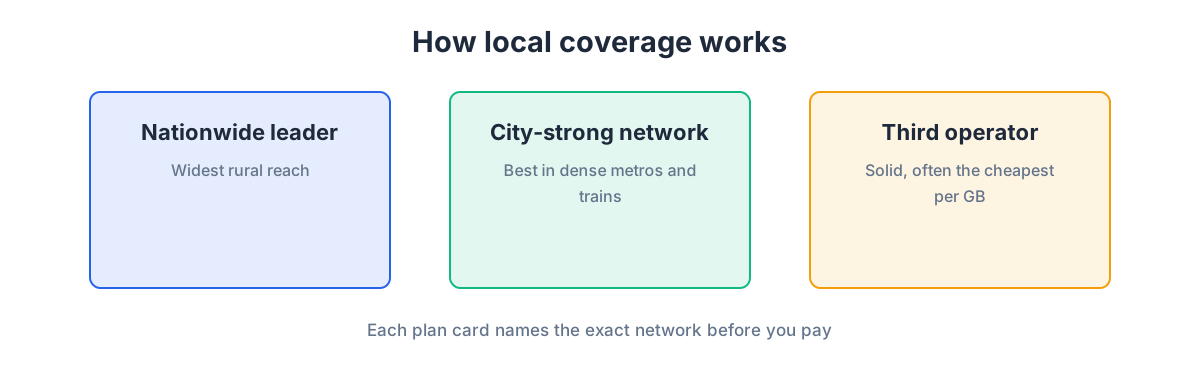
The practical rule for the UK is to download offline maps and any hiking routes before you leave the last town. In cities and on trains between them your eSIM behaves like a normal local line. On a ridge walk in Snowdonia, no plan gives you full bars, so treat the eSIM as your city and transit connection and prepare offline for the wild bits.
Sizing your data for a British trip
UK trips tend to be city-heavy and transit-heavy, which shapes the data profile. You will lean on maps and live transport apps constantly, refresh rail and Tube status, and probably stream a bit in the evening back at the hotel or Airbnb. Navigation itself is light once tiles are cached; the bigger draws are social media, video, and photo backups after a day of pretty streets and skylines.
The data-budget diagram splits a typical day into buckets so you can build your own estimate instead of guessing at a single figure.
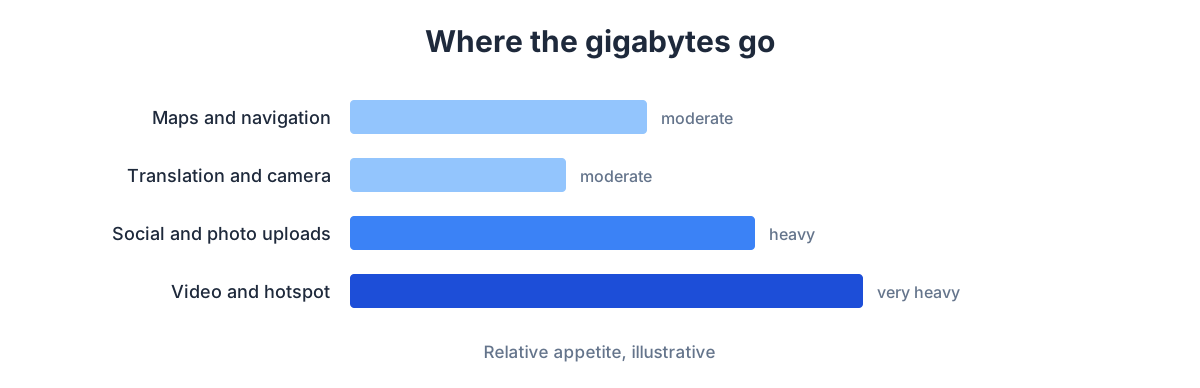
A light user, mostly navigating and messaging, gets by on a modest daily allowance. A moderate user who posts stories, checks social over coffee and takes the occasional video call needs more. A heavy user streaming shows and uploading video should buy generously. Because you can top up from the app in seconds without reinstalling, the sensible play is to start on the lower side and add data once you see your genuine daily use. Our companion guide on how much data you need for a trip runs the same numbers with examples if you want to be precise.
Setting up before you leave home
Install the eSIM at home, on your own Wi-Fi, a day or two before you fly. A traveler already at home provisions the profile there and simply switches it on after landing, which keeps the delicate step off your arrival to-do list. The flow is the same on iPhone and Android: buy the UK plan and confirm the plan card, add the eSIM in your cellular settings via the QR code or direct install, label the line something obvious like "UK data", and enable data roaming on that travel line (you are technically roaming onto a UK host network, but there are no roaming charges on the GetSim plan). Set the travel line as your data line and keep your home number on your other line for calls and texts. The step-by-step is in how to install an eSIM on iPhone and Android.
Confirm compatibility first. Recent iPhones, Pixels and flagship Galaxy phones generally support eSIM; the definitive check is to dial *#06# and look for an EID, or find "Add eSIM" in settings, as covered in the phone compatibility guide. To shop, open the eSIM plans or the full country list and slot the UK in alongside the rest of your route.
Airports, the Tube and getting around
On arrival, take the phone off airplane mode and the eSIM should register on a UK network within a minute or two. Confirm the travel line is your data line and you are ready for the train into town. The UK is a place where a live connection genuinely smooths the journey: mobile rail and Underground tickets, real-time platform and delay updates, and contactless payment caps that reconcile in an app all assume you are online.
Two habits help. First, keep the eSIM as your active data line rather than hopping between café and hotel Wi-Fi, so live transport info is always to hand when a platform changes at the last second. Second, remember the data-only limitation: SMS verification codes go to a phone number, not a data line. If a UK bank, delivery service or booking site insists on texting a code to a local number, a virtual number (a receive-only rented mobile number in the same app) is the clean way to receive it.
Beyond the UK: Ireland, Europe and multi-stop trips
Few visitors treat the UK in isolation. A hop to Dublin, a Eurostar to Paris, or a wider European circuit are all common, and because every plan lives in one app on one shared wallet, adding the next country is trivial. If your route covers several European countries, it is worth comparing a regional plan against a stack of single-country plans to see which fits your itinerary better. The wallet balance is shared, so a single top-up covers whatever you activate next.
Travelers often pair the UK with neighbours: a France eSIM for a Eurostar weekend, or line it up before a longer continental loop that might include an Italy eSIM. Each plan installs the same way you have already learned, so the second country is faster to set up than the first.
Matching the plan to your UK trip
Instead of one blanket recommendation, match the plan to how you travel. The comparison below is deliberately qualitative; the exact data and price appear on the plan card at purchase.
| Trip style | What you'll do | Plan approach |
|---|---|---|
| London city break | Tube, maps, contactless, social, evening streaming | Mid-size daily budget with headroom for evenings |
| Business, few days | Email, calls over data, maps between meetings | Smaller allowance, short validity; top up on heavy days |
| Rail tour of Britain | Constant transport apps, some offline downloads, photos | Larger allowance, longer validity; pre-download rural maps |
| Highlands road trip | Navigation, offline maps for remote stretches | Moderate plan; expect signal gaps off the main roads |
The plan card is always the source of truth for network, data, validity and price, and unused, unactivated plans carry a 7-day refund, so there is no downside to buying a little ahead of the trip.
Keeping costs under control
The appeal of a UK eSIM over roaming is that the price is fixed and visible before you buy, not tallied against your home account while you sightsee. To make that certainty hold, the setup matters: keep your home SIM in the phone for your number but turn its data roaming off, and let the UK eSIM carry all data on its fixed allowance, which you can watch in the app. Because the plan card shows the network, data, validity and price up front, there is never a hidden surcharge, and if you get close to your limit you top up on purpose rather than discovering an overage after the fact.
A couple of small disciplines stretch a UK plan further. Push the heavy tasks, full-resolution photo backups, cloud sync, big app updates, onto hotel or Airbnb Wi-Fi rather than the cellular allowance. And if you are traveling as a couple or family, a single generous plan shared by hotspot is usually more economical than several separate small plans, since tethering behaves like a normal connection. Across a multi-country European trip, the shared prepaid wallet keeps everything in one balance, so you top up once rather than managing a separate account for each border you cross.
A few UK-specific practicalities
Britain has some quirks worth anticipating. Rail is the backbone of getting around, and it is the area where a live connection earns its keep: platforms change late, mobile tickets need to load, and delay-repay and replacement-bus information all live online. Keep the eSIM active on those journeys rather than trusting station Wi-Fi that may not reach the platform. Contactless is near-universal, from buses to museums, and while the payment itself does not need your data, the apps that track your daily fare caps and let you check journeys do. Weather is the other British constant; if a day walk in the Lakes or on the coast path is on the agenda, download the route and an offline map at the hotel, because the prettiest stretches are exactly where the signal thins. None of this is unique to a travel eSIM, but a connected phone turns each of these small frictions into a non-issue.
Frequently asked questions
Does one UK plan cover England, Scotland, Wales and Northern Ireland?
Yes, a UK plan is national and works across all four nations. Signal strength varies by location, dense in cities and along motorways and rail lines, patchier in remote uplands, but the plan itself does not change.
Will it work on the Underground?
Where the Underground has mobile coverage (an expanding set of stations and tunnels), yes. Elsewhere you drop offline briefly between stations, which is why downloading your journey and offline maps in advance is worth the minute it takes.
Can I use it as a hotspot for my laptop?
Yes, tethering works like a normal line. Just remember the laptop then shares your plan's data, so size accordingly or top up if you plan to work online.
How do I receive a UK verification text?
A data-only plan cannot receive SMS. Add a virtual number to catch codes on a receive-only UK number, kept in the same app and wallet as your data plan.
What happens to my home number?
Keep your home SIM in the phone for your number, but switch off its data roaming. The UK eSIM handles all data, so there are no surprise charges.
Run through this the night before
To pull the whole thing together, a quick run-through the night before you leave saves any last-minute stress. Confirm your phone supports eSIM with the *#06# EID check if you have not already. Buy the UK plan and read the plan card so you know your network, data, validity and price. Install the profile on home Wi-Fi and give the line a clear label. Turn data roaming on for the UK line and off for your home line. Download offline maps for any rural walks, and if a UK service will need to text you a code, add a virtual number in advance. Do those six things and arrival day is nothing but the train into town.
A UK eSIM turns one of the most phone-reliant destinations in Europe into a non-event: you land connected, tap through the Tube, and keep your itinerary in your pocket. Estimate your data from how you really travel, install at home before you fly, keep your home number on a second line, and reach for a virtual number whenever a British service wants to text you a code. The rest of the trip is just Britain.
Ready when you are
Put this guide to use on your next trip
Travel eSIMs that install in minutes and keep your home SIM active.