

France is a trip of two halves for your phone. In Paris it is a constant companion, guiding you between Metro lines, translating a brasserie menu, holding your museum timeslot for the Louvre, and summoning a ride when your feet give out. Out in the countryside, wandering Provence villages or driving the Loire's château route, it becomes a navigator and a camera. A France eSIM covers both modes: you land at Charles de Gaulle, Orly or Nice already connected, and stay online from the city to the vineyards without ever touching a physical SIM. This guide is for a visitor planning that mix, with coverage, data sizing and setup laid out plainly.
Photo: Chris Karidis / Unsplash
The GetSim setup is straightforward. You buy a France data plan before you travel, the plan card shows the network, the data, the validity and the price up front, and the profile installs onto the eSIM slot your phone already has. Most travel plans are data-only, which fits a French trip cleanly, since maps, messaging, calls over apps and mobile transit tickets all run on data. France is one of 190+ destinations in a single app with one shared prepaid wallet, so it pairs easily with the rest of a European route.
Coverage from Paris to the provinces
France has broad, reliable coverage across the areas visitors gravitate to. Paris is thoroughly covered, including much of the Metro and RER network, and the same is true of Lyon, Marseille, Bordeaux, Nice and the other cities, along with the TGV lines and autoroutes linking them. For a city-plus-day-trips itinerary, a France eSIM behaves like a normal local connection throughout.
The softer spots are the rural interior and the high ground: deep Provence back roads, parts of the Alps and Pyrenees, remote stretches of the Massif Central, and small coastal hamlets. Coverage there is usually workable but not guaranteed, the same reality local subscribers live with. Read the network diagram below as a hedged, tiered picture: a nationwide leader with the widest reach, a strong-in-cities competitor, and a third operator, with your travel data riding on established host infrastructure rather than a network you pick by hand.
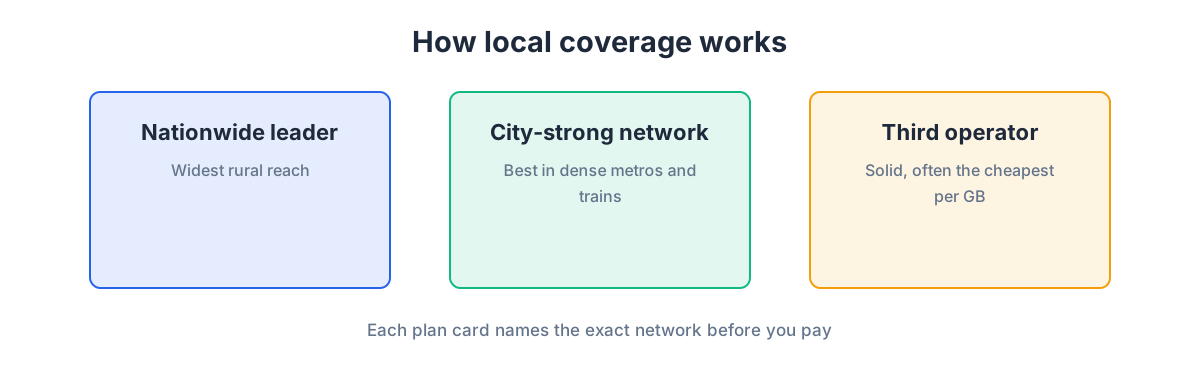
The habit that pays off in France is to download offline maps before heading into the countryside or the mountains. In Paris and along the TGV routes your eSIM is effectively a local line; on a winding road through a Provençal valley, cache your route and you will not miss a turn even if the signal dips.
Sizing your data for France
A French trip usually blends heavy navigation with a fair amount of photography and evening downtime. Maps and messaging are light once tiles cache. The bigger consumers are social media as you share the view from Montmartre, video calls home, streaming in the evening, and photo backups after a day among lavender fields or Haussmann façades.
The data-budget diagram splits a day into buckets so you can build your own estimate rather than trusting one figure.
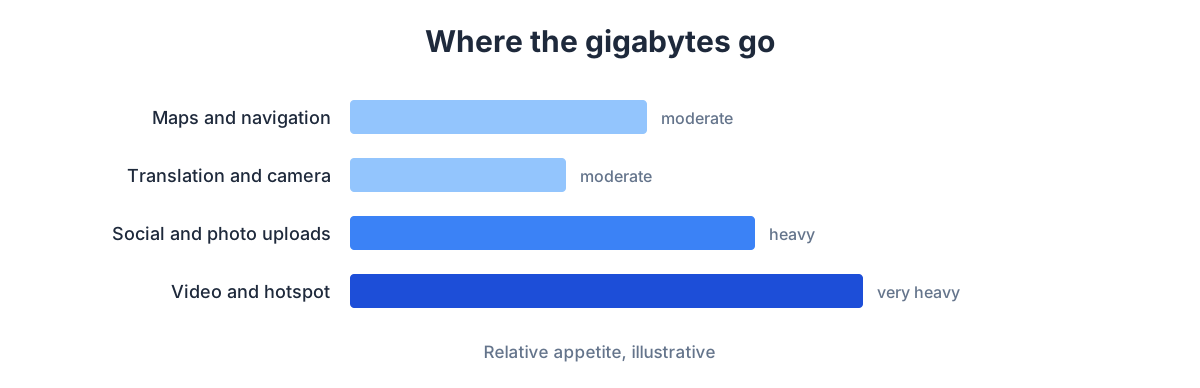
A light user who navigates and messages runs on a small daily allowance. A moderate user posting stories and taking the odd video call needs more. A heavy user streaming and uploading video should buy generously. Because top-ups happen in seconds in the app with no reinstall, start on the smaller side and add data once you see your real daily use. Our guide on how much data you need for a trip works through the same math with examples.
Setting up before departure
Install the eSIM at home on Wi-Fi a day or two before you fly. A traveler already at home provisions the profile there and simply switches it on after landing, keeping the delicate step off your arrival list. The flow is identical on iPhone and Android: buy the France plan and check the plan card, add the eSIM in cellular settings via QR or direct install, label it something clear like "France data", and enable data roaming for that travel line (you are roaming onto a French host network, but with no roaming charges on the GetSim plan). Set the travel line as your data line and keep your home number on the other line. The screen-by-screen walkthrough is in how to install an eSIM on iPhone and Android.
Confirm compatibility first. Recent iPhones, Pixels and flagship Galaxy phones generally support eSIM; the definitive check is dialing *#06# for an EID or finding "Add eSIM" in settings, as the phone compatibility guide details. To shop, open the eSIM plans or the full country list and add France next to the rest of your itinerary.
Arrival, the Metro and getting around
After landing, take the phone off airplane mode and the eSIM should register on a French network within a minute or two. Confirm the travel line is your data line and head for the train into the city. France rewards a live connection: mobile Metro and rail tickets, real-time transit updates, timed museum entries and restaurant bookings all assume you are online.
Keep the eSIM as your active data line rather than juggling café Wi-Fi, so transit and booking apps are always ready. And remember the data-only limitation: SMS codes go to a phone number, not a data line. If a French service, a bank, a delivery app, or accommodation, insists on texting a code to a local number, a virtual number (a receive-only rented mobile number in the same app) receives it without fuss.
Beyond France: a wider European trip
France is often the anchor of a European tour, with onward legs to Italy, Spain, or the UK. Since every plan lives in one app on a shared wallet, adding the next country takes seconds, and for a route spanning several countries it is worth weighing a regional plan against separate single-country plans. The shared balance means a single top-up carries over to whatever you activate next.
Travelers regularly pair France with neighbours they can set up identically, such as an Italy eSIM for a Riviera-to-Tuscany route or a Spain eSIM for a cross-Pyrenees leg. Each installs with the flow you already know, so the second country is quicker than the first.
Matching a plan to your France trip
Instead of a single recommendation, match the plan to your travel style. The table is qualitative on purpose; exact data and price appear on the plan card at purchase.
| Trip style | What you'll do | Plan approach |
|---|---|---|
| Paris city break | Metro, maps, museums, social, evening streaming | Mid-size daily budget with evening headroom |
| Business, few days | Email, calls over data, maps between meetings | Smaller allowance, short validity; top up on heavy days |
| Provence or Loire road trip | Constant navigation, offline maps, lots of photos | Larger allowance, longer validity; cache rural routes |
| Multi-city TGV tour | Rail apps, navigation, social, photos | Moderate-to-large plan across the whole trip |
The plan card is always the source of truth for network, data, validity and price, and unused, unactivated plans keep a 7-day refund, so buying ahead carries no risk.
How to keep a French bill from surprising you
Cost certainty is a major reason travelers pick an eSIM for France over roaming. The plan is bought up front at the price on the plan card, so nothing runs against your home account and no bill follows you home. The setup that locks this in is simple: keep your home SIM in the phone for your number but switch its data roaming off, and let the France eSIM carry all data on its fixed allowance, which you can watch in the app. If you get close to the limit, you top up deliberately rather than finding a surcharge later. And because top-ups are instant and need no reinstall, buying a modest plan first and adding data once you see your real use is a low-risk way to avoid over-buying.
Two small habits stretch a France plan. Push the heavy tasks, full-resolution photo backups, cloud sync, large app updates, onto hotel or gîte Wi-Fi rather than the cellular allowance. And for couples or families, a single generous plan shared by hotspot usually beats several small separate plans, since tethering behaves like a normal connection. Across a broader European trip the shared prepaid wallet keeps every country in one balance, so you top up once instead of managing an account per border.
What's peculiar to being online in France
France has a few habits worth planning around. Rail is central to getting between cities, and the SNCF apps that hold your ticket and flag platform or delay changes want a live connection, so keep the eSIM active on travel days rather than trusting station Wi-Fi. Popular sights, the Louvre, Versailles, the Eiffel Tower, increasingly run on timed-entry bookings held in an app, which again assumes you are online when you arrive. If your trip leans rural, a Provence road trip, a Loire château loop, or a Pyrenean hike, cache your maps and route in the last town with full bars, because the loveliest back roads and trails are exactly where signal fades for everyone. And because so much day-to-day French admin, from parking apps to restaurant bookings, runs on a phone, a connected line quietly removes a dozen small frictions before they start.
Frequently asked questions
Does one France plan cover Paris and the countryside?
Yes, a France plan is national and works everywhere. Only the underlying signal varies, strong in cities and along TGV lines, patchier in remote hills and mountains, exactly as for local users.
Will it work on the Paris Metro?
Across much of the Metro and RER, yes, with brief drops in some tunnels. Downloading your journey and offline maps in advance covers the gaps.
Can I tether my laptop or tablet?
Yes, tethering works like a normal line; the tethered device simply shares your plan's data, so size accordingly or top up if you plan to work online.
How do I receive a French verification text?
Data-only plans cannot receive SMS. Add a virtual number to catch codes on a receive-only French number, kept in the same app and wallet.
What about my home number?
Leave your home SIM in the phone so it still rings for your usual number, but turn its data roaming off. That single toggle sends every megabyte through the France eSIM and its fixed allowance, so nothing bills back to your home account while you travel.
The night-before checklist
Pulling it together, a quick check the night before you leave prevents any arrival-day scramble. Confirm eSIM support with the *#06# EID check if you have not yet. Buy the France plan and read the plan card so you know your network, data, validity and price. Install the profile on home Wi-Fi and label the line clearly. Turn data roaming on for the France line and off for your home line. Cache offline maps for any road-trip or hiking days in the provinces. And if a French service will need to text you a code, add a virtual number in advance. That short list is the difference between landing ready and landing hunting for signal.
Whether your France trip is a long weekend in Paris or a two-week loop through the south, the eSIM is the part you never have to think about once it is set up, which is exactly how it should be. You spend your attention on the museums, the markets and the drives, not on your connection, and the plan sits quietly in the background doing its job. That is the whole point of buying it before you go, and it is why setting up at home rather than at the airport makes such a difference to the first day of the trip.
A France eSIM handles both faces of a French trip: the connected bustle of Paris and the quieter navigation of the provinces. Size your data around city days and photo-heavy excursions, install at home before you fly, keep your home number on a second line, and lean on a virtual number whenever a French service wants to text you a code. Then you are free to focus on the important decisions, like which café terrace and which glass of something regional.
Ready when you are
Put this guide to use on your next trip
Travel eSIMs that install in minutes and keep your home SIM active.